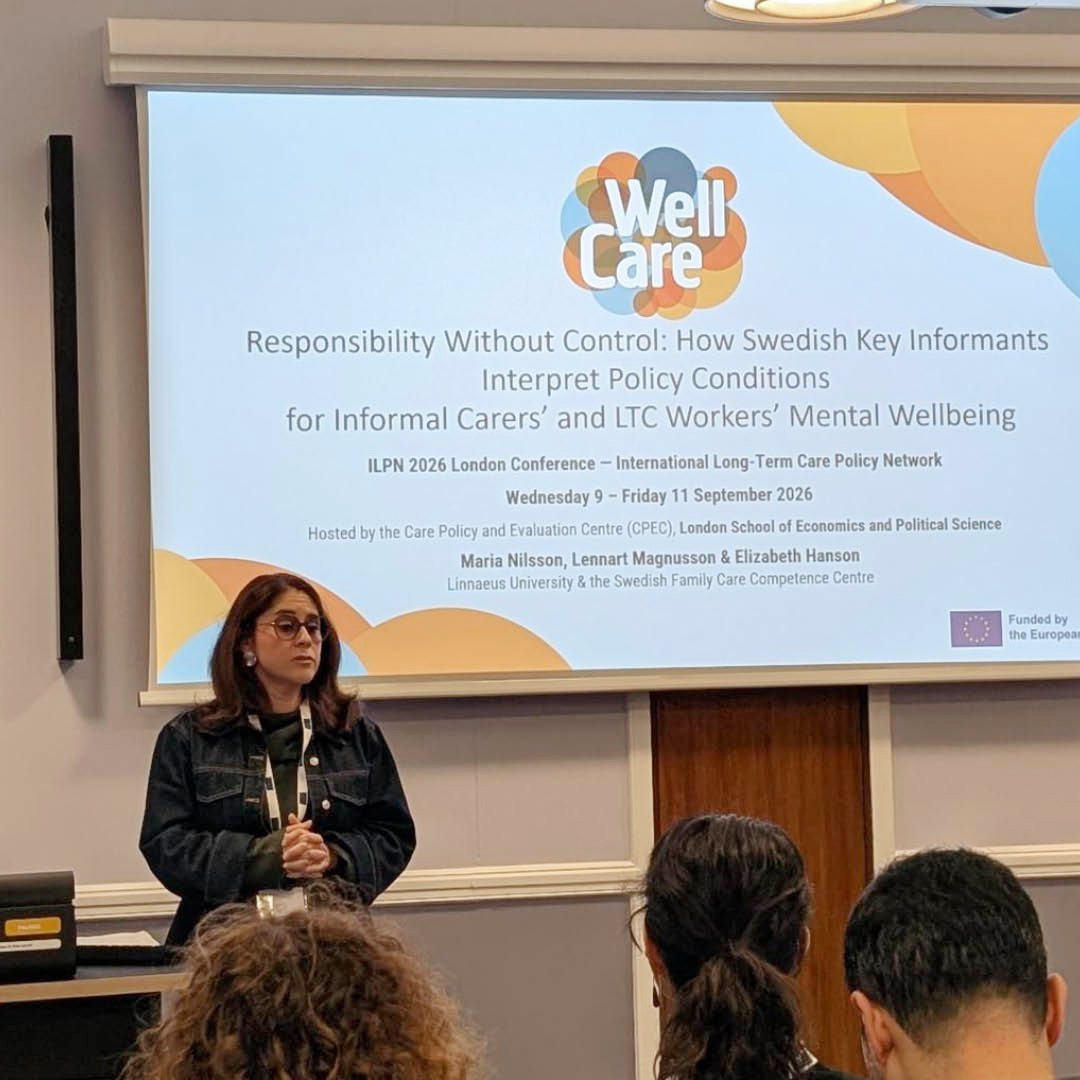
Maria Nilsson, Director of the Swedish Family Care Competence Centre (Nka), shared research from the…

First European Blended Learning Networks’ Session in Brussels
Sharing Perspectives and Ideas
On 6 November 2025, the WELL CARE project held its first EU-level Blended Learning Network (BLN) session in Brussels. BLNs are mixed groups of different stakeholders who meet to share knowledge and experiences and learn from one another. Within the WELL CARE project, national BLNs meet five times a year to provide input on different parts of the project and to ultimately facilitate change at the local, organisational, and/or national level.
The EU meeting brought together 39 participants including: BLN members and facilitators alongside work package leaders and EU-level project partners, Eurocarers (co-host), Mental Health Europe (MHE), European Association of Service Providers for persons with Disabilities (EASPD) and the European Ageing Network (EAN). We also had the honour to welcome the European Commission WELL CARE Project Officer, Sara Brazys.
Initial presentations
The session began with a warm welcome from the project coordinator and principal investigator, Elizabeth Hanson. Sara Brazys then presented mental health and current brain research within Horizon Europe, and Claire Champeix from Eurocarers provided an overview of how the WELL CARE project aligns with current EU policy initiatives on long-term care (LTC), including the ‘Care strategy’. These contributions helped place the project’s work within a wider European policy context.
Country snapshots
A key part of the day focused on country snapshots, where representatives from each partner country presented their national situation regarding informal care and LTC, with particular attention to the mental wellbeing and resilience of informal carers and LTC workers. In blended small-group discussions (a mix of partner countries and stakeholders), participants reflected on what inspired them, what could be transferred across countries, and where improvements are needed.
These exchanges highlighted both shared challenges and important differences between care systems, offering valuable European perspectives. Across the countries, a growing awareness of informal carers’ situation was noted, however common challenges included, for example, staff shortages, and concerns about long-term financial, and workforce sustainability. The key differences lay in how LTC systems are organised. Germany has a strong insurance-based system, but navigating it is highly bureaucratic, creating barriers for families. Italy has financial arrangements such as partial wage replacement for informal carers; the system, however relies heavily on migrant care workers (‘badanti’), who may be at risk of poor working conditions. The Netherlands has a growing community-based care model with strong local engagement, which appears to reduce reliance on institutional care, although it depends on citizens’ willingness to participate. Slovenia is in a phase of major system-building, introducing new legal and financial structures, including financial compensation for informal carers, the integration of health and social care, and clearer entry points to the system. Sweden has a tax-based, rights-oriented model with voluntary informal care and relatively broad access to support, though at a high public cost, raising questions about future sustainability.
Implementation sites and solution prototypes
In the afternoon, attention turned to the implementation sites and possible solution prototypes. In each of the partner countries, at least one solution prototype will be developed—such as a new way of working or an educational initiative—with the aim of increasing mental well-being and resilience among informal carers and LTC workers and fostering care partnerships between them. The country partners shared early ideas and received feedback from the participants, providing further insights.
- Germany presented the idea of developing two national preventive courses for informal carers, as well as for their key persons and supporters.
- Italy presented two ideas aimed at strengthening cooperation among residents, families, and staff, and supporting their mental well-being within the organisation CADAI, through an Individualised Care Plan (PAI) and a mindfulness-based stress reduction programme.
- The Netherlands presented two ideas/implementation sites: (1) collaboration between a LTC organisation and a community initiative, QuaRijn and BunnikSamen, both aiming to move towards a “caring community”, (2) focus on people with intellectual disabilities and their families within the Hartekamp Group. The choice of solution prototypes will be co-developed with the different sites.
- Slovenia presented the idea of leadership training combined with strengthening carers’ knowledge, skills, and self-care within the Age-Friendly Municipality of Komenda.
- Sweden presented three implementation sites: group homes with special services for people with disabilities in Eskilstuna municipality, respite homes in Borås municipality, and the process during the waiting period for a place in a nursing home in Kalmar municipality. The solution prototypes will be selected through a co-creation process with the different stakeholders at each of the three sites.
The discussions emphasised the importance of solutions that are concrete, sustainable, and grounded in the real needs of informal carers and LTC workers.
The session concluded with a joint wrap-up, informal networking, and a social dinner, where Belgian moules-frites were offered for those eager to taste this local delicacy. The BLN session was followed the next morning by a visit to the European Parliament. Overall, the Brussels meeting was felt to have strengthened participants’ connections, engagement, and understanding of the WELL CARE project, and it also provided insights into the challenges faced in different countries, helping to prepare for the next phase of the WELL CARE project, where locally adapted solutions will be further developed to support the wellbeing of informal carers and LTC workers in Europe.
Authors: Elin-Sofie Forsgärde, Elisabeth Hanson, Linnaeus University
Picture: Almost all the participants who took part in the EU BLN session, pictured here outside the European Parliament.
Related Posts