What does long-term care policy do to the people who actually provide care? That question…

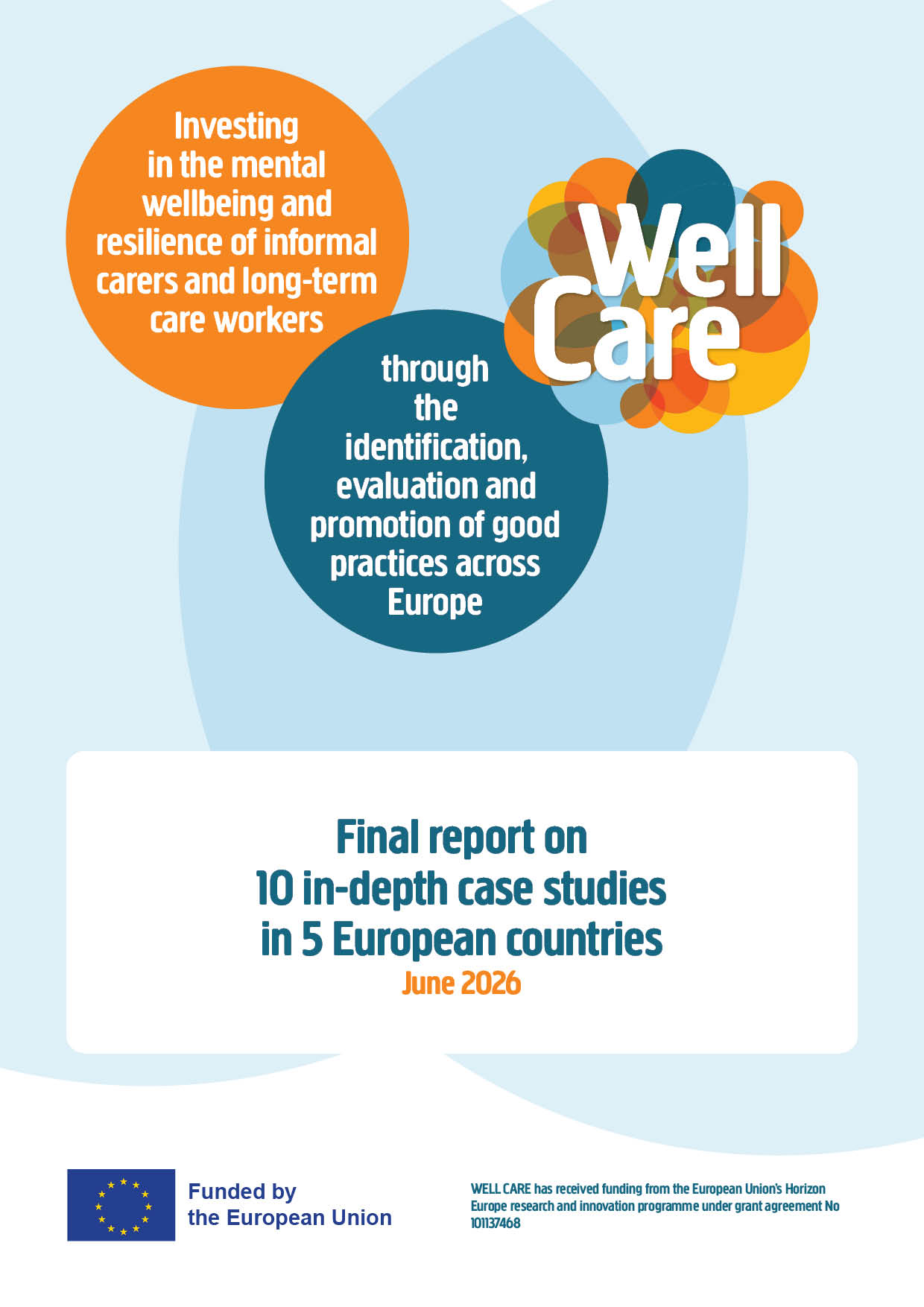
Launch of the WELL CARE report on 40 good practices in 5 European countries
The WELL CARE project aims to identify good practices that improve the mental health and resilience of long-term care workers and informal carers of older, frail and/or disabled people, while preventing or mitigating both occupational and non-occupational risks linked to personal and socio-economic factors. The final report on 40 good practices in 5 European countries presents the results of a pivotal work package led by INRCA, with the collaboration of all partners, focusing on innovative practices identified through a shared conceptual framework, evidence drawn from a scientific and grey literature review and inputs provided by expert interviews and Blended Learning Networks.
This report reflects a systematic process carried out by the project consortium to identify, review, evaluate and rank a total of 170 good practices from across Europe. While some practices are implemented in the partner countries, others originate from additional EU Member States, the United Kingdom and EFTA countries. The selection approach applied is transparent and flexible, allowing project country partners (Germany, Italy, the Netherlands, Slovenia and Sweden) to draw on the systematically ranked practices on the basis of agreed EU-level criteria, for informing the next phases of the project.
The breadth of the identified practices provides a strong evidence base to support informed choices and adaptation to different national and local contexts. Most of the identified top 40 ranked good practices have the potential to foster care partnerships, even though it is variously shaped, encompassing e.g. web-based tools, group discussions, training courses, interactive group sessions, meeting centres, social and healthcare facilities. Within these good practices, care partnerships were seen to be the foundation of:
– support interventions promoting collaboration, mutual recognition of roles and shared responsibility in caregiving;
– initiatives aimed at knowledge sharing or integration of care among informal and formal care systems and providers;
– programs to improve the management and provision of care through a more active role of informal carers in care design and delivery.
The identified good practices inform the development of prototypes in the current stage of our project, aiming at enabling local, regional and national partners and stakeholders to implement and evaluate tailor-made solution prototypes, in collaboration with Local Implementation Teams and Blended Learning Networks.
Overall, the findings contribute to advancing knowledge in the fields of mental health, informal care and long-term care, with relevance for older people, people with disabilities and individuals living with chronic conditions.
The results also have important policy implications, particularly regarding the sustainability, scalability and transferability of good practices. Our findings confirm that sustainability depends not only on long-term funding, but also on political support, workforce capacity and coordination among stakeholders. The findings highlight the central role of informal carers and the need to strengthen care partnerships between informal and formal carers. The top-ranked practices demonstrate that such partnerships are a key lever for improving mental wellbeing, reducing care burden and enhancing the quality of care across European long-term care systems.
Read the WELL CARE report on 40 good practices in 5 European countries
Related Posts